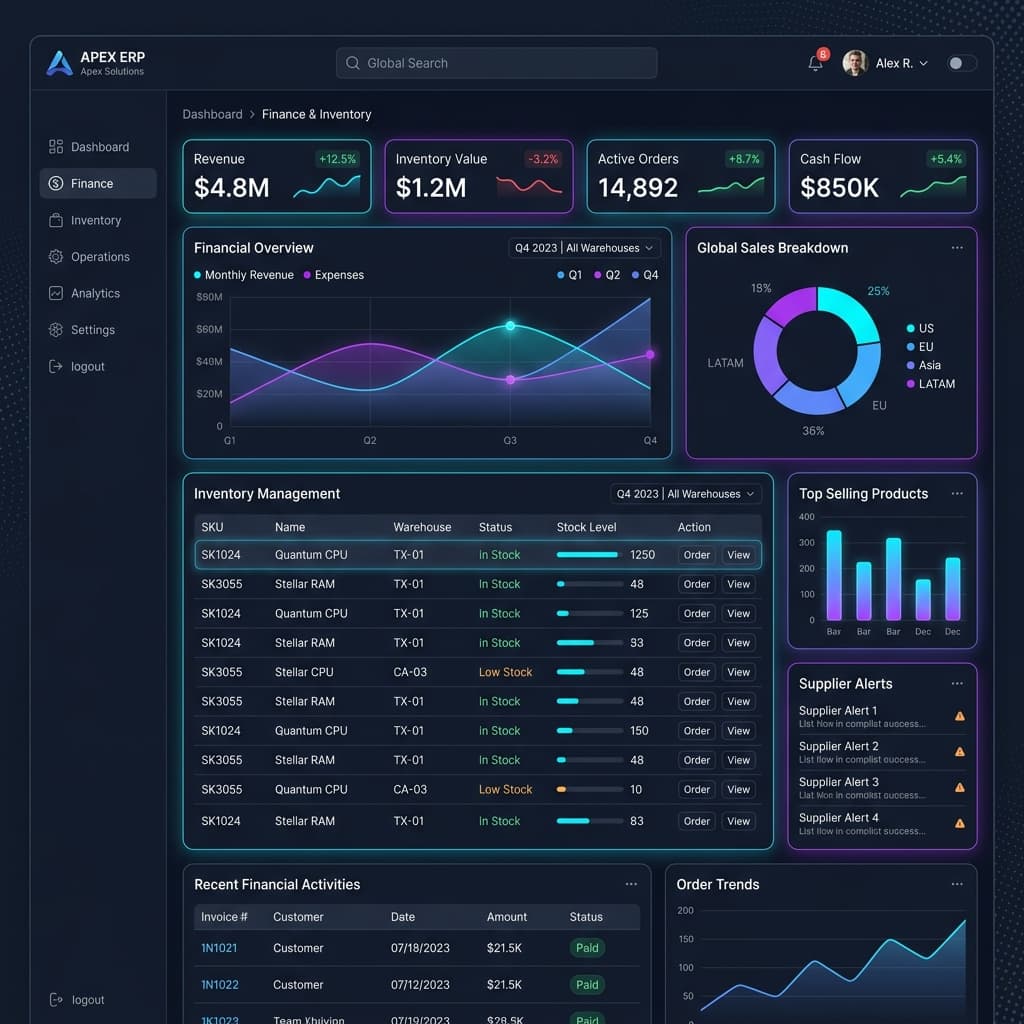
How to Choose ERP Software in Kenya
Growing businesses in Kenya face a common challenge: managing operations across multiple disconnected systems. Your inventory is in one place, finances in another, HR in a spreadsheet. It's chaos.
ERP (Enterprise Resource Planning) software consolidates everything into one system. But choosing the right ERP is critical — the wrong choice can cost you more than just money.
The Real Cost of Getting It Wrong
A poorly chosen ERP system can:
- Disrupt your operations for months during implementation
- Cost more than expected due to customization and training
- Become obsolete as your business grows
- Lock you into a vendor relationship that doesn't serve you
We've seen businesses spend millions on ERP systems that don't fit how they actually work. That's why this choice matters.
What to Look For
1. Does It Fit How You Actually Work?
This is the most important question. Generic software forces you to change your processes to fit the system. Custom software (or highly configurable ERP) lets the system work around your processes.
Ask:
- Can it handle your specific workflows?
- Does it support the way you manage inventory?
- Can it track your unique KPIs?
If the answer is "you'll need to change how you work," keep looking — or consider custom development.
2. Integration with Your Existing Tools
You likely already have:
- Accounting software
- CRM for customer data
- Payroll system
- E-commerce platform
- Delivery/logistics tools
Your ERP needs to integrate with these, not replace them. Integration saves time and reduces data duplication.
Ask:
- Can it connect to our existing tools?
- How easy is the integration? (Days? Months?)
- What's the long-term maintenance cost?
3. Scalability
Can your ERP grow with you?
A system that works for 5 users might struggle at 50 users. A system built for 100 transactions per day might crash at 1,000.
Ask:
- How many users can it support?
- What's the transaction limit?
- How does performance degrade as you scale?
4. Cost Transparency
ERP costs have multiple layers:
- License/subscription cost
- Implementation and setup
- Customization for your business
- Training for your team
- Ongoing support and maintenance
Some vendors hide costs until you're committed. Get everything in writing upfront.
Typical ERP costs for Kenyan SMEs:
- Small systems: KES 100k - 500k
- Medium systems: KES 500k - 2M
- Enterprise: KES 2M+
Plus implementation: Often 50-100% of software cost.
5. Local Support
ERP implementation is complex. You need local support — people who understand Kenyan business context, language barriers, time zones.
Ask:
- Do they have a local support team?
- How fast do they respond to issues?
- Can they train your team?
Common Mistakes to Avoid
Mistake 1: Choosing by Price Alone
The cheapest ERP often costs the most. Poor implementation, lack of support, and misalignment with your processes create massive hidden costs.
Mistake 2: Ignoring Change Management
50% of ERP failures aren't technical — they're human. Your team resists change. Without proper training and change management, adoption fails.
Mistake 3: Thinking You Can "Figure It Out Later"
Implementation planning must happen upfront. "We'll sort out the details during implementation" leads to scope creep, delays, and budget overruns.
Mistake 4: Underestimating Customization Needs
Generic ERP out-of-the-box never fits perfectly. Budget for customization and integration work. This is where most of your costs actually go.
The Right Approach
1. Understand your current state — Map out all your existing systems and processes
2. Define your needs — What problems are you solving? What should the system do?
3. Get multiple options — Compare 3-5 solutions with your specific requirements
4. Do a pilot — Test the system with a subset of your operations before full rollout
5. Plan change management — Train your team extensively. Support adoption.
6. Budget realistically — Software cost is often only 20-30% of total ERP cost
For Kenyan Businesses
Kenyan SMEs have unique needs:
- Integration with mobile money (M-Pesa, Airtel Money)
- Support for multiple currencies and tax rules
- Handling informal payment methods
- Local currency volatility
- Limited internet reliability
Any ERP you choose must account for these realities.
Custom vs Off-the-Shelf
Sometimes, a custom ERP makes more sense than forcing your business into generic software. If your processes are unique or complex, building custom saves long-term pain.
Cost comparison:
- Off-the-shelf ERP with heavy customization: KES 1-3M + ongoing licensing
- Custom ERP: KES 1.5-5M upfront, minimal ongoing costs
For businesses with unique needs, custom often wins financially over 5+ years.
The Real Question
The right ERP isn't the most popular or the cheapest. It's the one that:
- Fits how you actually work
- Integrates with your existing systems
- Scales with your growth
- Has support you can rely on
- Doesn't require you to compromise your processes
Take time with this decision. An ERP is a multi-year commitment. Get it right.
Need help evaluating ERP options for your business? At Byte Nuru, we help Kenyan businesses choose and implement custom ERP solutions that actually fit. Get in touch.